My Brain’s Going to Bust if I Learn One More Thing!

Don’t you feel that
way sometimes? Like your brain will explode if someone sticks one more bit of
data inside it?
 
Yea everyone is
always talking about, learning organizations, process improvement, continuous
education, blah, blah, blah!
 
With technology
always nipping at our heels there seems to be a constant effort placed on
technical learning or the latest and greatest new systems. I understand. That
stuff is necessary.
 
But I am speaking
about a different kind of learning. The kind that won’t mess up your
cubicle-mate with your bloody grey matter!
 
That is learning
about other people and how deal with them better. Imagine that! Can such a
thing be learned? YES and it won’t make your skull burst!
 
I am speaking,
for example, of learning how to motivate, inspire and incite enthusiasm in
others in a GENUINE way.
Leaders and their
employees who develop the capacity for self-analysis and adaptive learning will
have a remarkable competitive advantage in the future. The future will not be
based on technology, cool products, faster solutions or sexy ergonomics. It
will be based on the strongest relationships.
 
I have seen what
can happen when there is a greater commitment to work ON improving business
relationships rather than just the business deliverables. People in the firm
become highly engaged, client loyalty improves, revenue and profits grow,
employee turnover drops, new initiatives can be launched quickly and effectively,
market differentiation occurs, employees give not out of obedience but out of
discretionary effort and there is cooperative, harmonious teamwork. People go
BEYOND what is expected of them.
 
This is not a
dream. It can be a reality. I have seen it with my own eyes. It is important to
understand that this is NOT exclusive to my consulting practice. I know several
consultants, like myself, who employ similar tactics with similar positive
results. You see, in business, as in medicine there is a new standard of care.
It is a standard that focuses on preventative maintenance and improving health
rather than merely treating symptoms and constantly fixing aches and pains.
 
But as in
medicine, the patient must believe they need to become healthier in order to
accept treatment. You may be making money, but this is not the only measure of
health. Ask yourself these questions:
 
• Is there a high
employee turnover rate?
• Is there
political infighting, blame shifting or a lack of accountability among your
employees?
• Is there an
absence of discipline or self-centered attitudes?
• Do the people
in your workplace really enjoy coming to work or is it drudgery?
• Are the excited
to give their best?
• Do they feel
appreciated and significant?
• Have
dysfunctional behaviors like dishonesty, insubordination or emotional outbursts
occurred in the workplace during the last six months?
 
If any of these
symptoms are present in your business, its time to think about making some core
changes to your business culture. These changes begin with the ability to cope
with the unrelenting daily change in our society and economy. They are an
outgrowth of our ability to change ourselves first BEFORE expecting others to
change. They are interwoven with our commitment to a pre-defined, consistent value
set. And they are an example of our ability to hold others accountable for peak
performance rather than just mediocrity.
 
At the SBA
Network we like to say that we influence decisions, improve performance and
inspire change. Let us know how we might be able to assist you to inspire
change in your organization.
 
Mark Deo
310-963-1145
When Coaching Doesn’t Work

Whether you are a manager who needs to coach your team, or a professional coach working with a client, it is critical to understand the conditions which must exist for performance coaching to be effective.

Oftentimes we misdiagnose a performance gap as requiring “coaching.” Coaching isn’t always the right solution. When people need to be told what to do we can advise them, when people need to know how to do something they can be trained, but when people need someone to help them to do it themselves this is when coaching is most effective.

In pure coaching engagements the coach never tells the client (or team member) what they should do but rather allows them to make the decisions and select their own path. The coach merely guides the subject by asking the right questions and attempting to uncover the reasons for the attitudes, habits and behaviors and gently assists them in discovering the best solution through facilitating a dialog.
When coaching is ineffective it is often resisted and this might block the individual’s growth or performance improvement. Here are some of the key reason’s which cause others to resist coaching:

Consumes Too Much Time
Surely coaching requires a commitment of time (possibly even dollars) from the subject. Some coaching happens monthly or weekly or even daily. There is no prescribed frequency or duration of time earmarked for coaching sessions. That said the time/dollars invested by the subject must at least be equal to the benefit received. In fact the subject is expecting to gain significantly more value from the coaching arrangement as compared to the time or dollars invested. For this reason the coach and subject must together develop a plan of “desired outcomes.” The success of the coaching engagement should be measured based on the degree to which these outcomes are realized. Since the benefits of behavioral change are massive the return on the coaching should represent a high multiple of the time/dollars invested.

Respect or Trust is Absent
In order to influence others we must be respected by them. If the coaching being provided is not “perceived to be” in the best interest of the subject; the coaching arrangement will fail. This is why forcing someone to engage in coaching is hardly ever productive. The relationship between the coach and the subject is an intimate one. Rather sensitive issues will be addressed and the subject must be able to trust the coach in order to communicate in a transparent manner. On the other hand when trust and mutual respect are achieved the result of the coaching arrangement can be rather significant.

It’s Intimidating
If coaching is not carefully facilitated the result might be the subject feeling unmotivated or ill confident. Too much pressure for change being exerted on the subject can have a contrary effect causing them to believe the possibility of behavioral change is not achievable or even warranted. Their confidence in their abilities might wan. Some coaches still believe that pushing people very hard is the best way to inspire peak performance. This can’t be argued looking at the statistics but there is a more pure way to incite change in behaviors. Genuinely helping to “build confidence” in the coaching sessions is a powerful way to engage the subject to tap into their self-potential. When the subject believes that the coach has pure motives they tend to apply themselves and embrace change more readily.

Some People Are Just Not Coachable
Coaching is not for everyone. There are those who reach their level of competency (or incompetency) and simple plateau-out. They feel leaning of a coach is akin to a character weakness. There are a number of signs which are indicators that a person is not coachable. First; they may not believe they have a problem but in fact, everyone else is the problem. Second; they may be stuck on behaviors which they believe to be the most effective yet blind to evidence of the contrary. Third; they just may be in the wrong job or pursuing the wrong strategy which they are too personally aligned with to back-off. It’s hard to help people who don’t think they have a problem. It’s impossible to fix people who think someone else is the problem. This is a clear sign that coaching may not be the right solution.

Whether you are a coach, someone being coached or someone looking for a coach it is critical to recognize the impediments to coaching. In doing so we might save someone and ourselves the heartache of attempting to bring about unwanted change.

On the other hand most good leaders are self-reflective and focused on continuous improvement. They know that success is not a destination but a journey and are always seeking ways to improve their competencies and behaviors. Next time you are tasked with coaching someone or even being coached think about these four impediments and answer the question, are these behaviors present?

If so, head for the door!

8 Tips For Employee Engagement

As simple as this sounds, actively engaged employees exhibit certain tendencies – tendencies that will make any business much more productive.

According to a Towers Perrin study of 90,000 employees in 18 countries conducted in 2007-2008, companies with the most engaged employees had:

A 19% increase in operating income during the previous year; while those with the lowest levels had a 32% decline.

Overall, employees are happy when they enjoy their work and they see their part in the organization’s progress. What can you do to actively engage your employees?

Tip #1: Create Activities Outside Of The Office – Employees enjoy socializing outside of the workplace. Once per season, create an activity outside of the office, such as a scavenger hunt, bowling outing or picnic.

Tip #2: Eat Lunch With Your Personnel – While understanding each person’s job function is important, you should also be aware of your employees’ feelings about processes and procedures. Host an informal lunch on a Friday afternoon to encourage general chat and to assess your level of employee engagement.

Tip #3: Encourage Experimentation – Innovation and productivity happens when employees are encouraged to have some time and space to come up with new ideas. Create a workspace that encourages brainstorming.

Tip #4: Establish Weekly One-On-One Meetings – A short, 5 to 15 minute weekly status meeting can really help you connect with each employee and monitor progress. These meetings also give your employees a chance to discuss any concerns.

Tip #5: Interact With Your Employees – Walk around and talk to your employees every now and then. Check in and observe their progress. This also keeps you involved in each aspect of the operation of your business.

Tip #6: Provide A Sense Of Completion – Most employees crave change, especially if their job duties are repetitive. Once a project or major task is complete, encourage the sense of completion that comes along with it. Allowing this to happen will increase employee retention and the general feeling of accomplishment in your corporate culture.

 Tip #7: Reward Positive Behavior – Always praise positive behavior and reward success with your employee engagement goal in mind. Provide incentives for helpful ideas that can increase sales or productivity.

Tip #8: Survey Your Employees – Employee engagement is measurable. You can judge your level of employee engagement and obtain metrics by creating and distributing a simple employee engagement survey. Be sure to include some extra space for additional comments or ideas. To measure your success, distribute this survey quarterly or semi-annually. You also might want to provide a gift certificate to the best suggestion to improve the company.

Executive Summary: Employee engagement involves an investment of time (and very little money). Once you do invest more time with your employees, it will result in new ideas, higher productivity, lower turnover and a better work environment for everyone; therefore, investing in meeting your employees’ intrinsic and extrinsic needs will provide you a huge competitive advantage in today’s competitive economy.

Let us know what we can do to help your firm fully engage your team members.

The Wrong Way to Increase Productivity


All businesses are challenged by requiring increased efficiency and productivity at a time when their workforces are already doing more than ever before. A desire to shift to a collaborative work environment to ramp up efficiency is quickly gaining traction. According to a recent study by IBM, collaboration is the number one trait CEOs expect from their employees. When employees’ sense of purpose becomes better aligned with the organization’s they are then more engaged and eager to contribute toward achieving the company’s ultimate objectives.” You don’t need to resort to drastic measures. In fact the most practical communication and crossfunctional solutions are the most effective. When properly implemented, people strat collaborating like never before!

The Importance of Family Businesses in America

Family businesses are the most influential factor in the health of the U.S. economy and they are the ONLY solution to our difficult economic times.

This statement might surprise many people but consider the statistics. According to Family Business Review Magazine family businesses comprise 80% of all business enterprises in North America. They account for 60% of total U.S. employment, 78% of all new jobs, 65% of wages paid  and 34% of these companies are listed on the Standard & Poor’s 500 Index. With those stats as a backdrop, it’s not surprising that nearly 40% of family businesses in America will be passing the reigns to the next generation over the next five years according to Business Week Magazine (August 11, 2003).

Yet the most incredible statistic by far was the one postulated by Robert Avery at Cornell University in his paper, “The Ten Trillion Dollar Question: A Philanthropic Gameplan.” Avery noted that by 2050, virtually all closely held and family owned businesses will lose their primary owner to death or retirement. Approximately $10.4 trillion of net worth will be transferred by the year 2040, with $4.8 trillion in the next 20 years.

The plain fact is that family businesses are in trouble because succession plans are quite obviously less and less effective. This is primarily due to what I call the “motive gap” between generations. According to an article appearing in the Boston Globe, only 40% of family owned businesses survive to the second generation, 12% to the third, and 3% to the fourth. It s also a known fact that these companies are most successful when run by a family member. Family members have the passion, drive and purest motives to run the company in a way consistent with the founding member. While some of these companies will be successfully sold to those outside the family, these statistics represent a disturbing trend and concern for the future of family businesses and the American economy in general!

It doesn’t take a genius to figure out that the root of this problem, simply said, is that sons and daughters are not interested in taking over the family business. Now this may well be attributable to other interests and passions. Certainly this is understandable but it does beg the question of WHY they may not interested or excited about learning the ropes and assuming the reigns? I can tell you that after personally working with thousands of family businesses and in may cases counseling numerous reluctant second or third generation leaders this stems from significant generational differences. These differences can easily be reconciled but often both parties (parents as well as sons and daughters) seem to be completely oblivious as to the differences. The result of generational differences are often mistaken as ineffective work habits, personality flaws or other personal characteristic or attributes. Yet more often than not simply becoming aware of the differences in generational decision making, communication and leadership styles can resolve conflict and restore trust and continued harmony in the business.

This allows the business to thrive even in difficult circumstances.

Mission Clueless

Merely hanging your mission
statement in the lobby or putting it on the back of business cards will not
ensure that your people are “living it.”  Simply doing this demonstrates that leaders
are clueless to the real mission – “making believers of their people!”  Certainly articulating the company’s mission
and specific goals is important but it is even more critical to incite genuine
belief, a deep faith and a burning desire among your team to live-out those
plans on a daily basis. This cannot be accomplished with mere words. It must be
demonstrated by the leaders in the firm with shoulder-to-shoulder unity. When
team members experience this they will then believe that the mission is real…
that the leaders themselves are living this out even under difficult
circumstances.  Don’t be clueless; make
your company’s mission-possible! Providing your people with the skills they
need is the only way to achieve your vision.

Storytelling

Let me ask you a question. Where do you find inspiration from? Movies, music, books, magazines, seminars, friends, family, co-workers? – Maybe from all of those places.

Let’s face it inspiration comes from stories that we hear from other people tell. How they beat the odds, achieved growth, or found a better way, it’s all in the story.

You know storytelling has been around for hundreds of years. From the beginning of time, storytelling has been the means by which cultures and societies have preserved and celebrated their memories, passed on their values and belief systems, entertained, instructed and reported. Long before there were written records, storytellers taught through the oral tradition. It was true in the bush, it’s true in the boardroom and it’s true everywhere in between.

In fact I think true leadership is the effective communication of the story. Our American culture seems to underestimate the power of storytelling. But think about how powerful a story can be when you’re in front of a client. Tom Peters says, stories are the red meat that meets our reasoning process. Stories give us permission to act, they are photographs of who we aspire to be, and they cause the most emotional responses. Stories are how we connect with people.

Falling Asleep on the Job

Achieving
organizational behavioral change must occur first with leaders. Employees
are very good at picking-up signals from management. They observe much more
closely how leaders ACT versus what they SAY. When there is conflict between
these two behaviors, team members are hesitant to change their own behaviors.
But when there is alignment, leaders are credible and win followers. This
behavior is less inborn than learned. When effectively leveraged it produces
engagement, accountability and a passion among team members. In short it changes
behaviors.  Winning
accountable behavior requires authentic role modeling. This means leaders must
learn how to embrace change. When they do the magic begins to happen!

Typical Training is for Pets

Training
our people to be more compliant and follow policies and procedures just doesn’t
work. They often politely listen and tell us precisely what we want to hear yet
fail to make significant, sustainable change. When self-driven behaviors are
adopted team members perform with greater passion and engagement. They make
better decisions and create more consistent results. Don’t  train your
people like they’re pets. They need practical and relevant solutions to today’s
difficult business challenges.


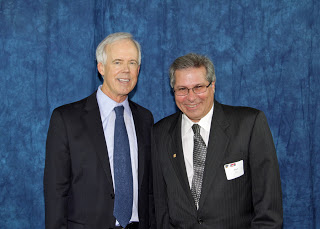
Mark Hobnobs with Congressional Candidate

Here I am with Bill Bloomfeild who is running for Congress in the 72nd District. I know Bill from our long association with Wash Laundry Service here in El Segundo. What I like about Bill is he is an independent and doesn’t talk bad about the Rpublicans or Democrats. In fact his whole platform is finding a way to bridge the rediculous partisan gap with just common sense and a little hard work. Check him out at www.bloomfeildforcongress.com